skincare

(Zensation Bio Regenerating Serum)
(image from Zensation Skincare)

Zensation Bio Regenerating Serum with Liposomes & Matrixyl® is a light-weight serum that is absorbed relatively well. Whether it has sufficient anti-aging efficacy is another matter.

There are some notable pluses and minuses. It is alcohol-free, which is always ideal. (It is surprising that many serum-type products that claim to be ultra-moisturizing have alcohol, which does the exact opposite from moisturizing the skin.) Also, if parabens are your concern, then this paraben-free serum might be worth considering.

It contains a very small amount of echinacea (coneflower) extract, which can have soothing properties.

However, it contains rose flower oil and pineapple extract, both of which can be skin irritants.

The trademarked ingredient, Matrixyl®, is Palmitoyl Pentapeptide 3. (It is listed as Palmitoyl Pentapeptide 4 on the packaging, but both go by the same trade name.) There is non-independent research showing it performs better than retinol and vitamin C. Even if this happens to be the case, Palmitoyl Pentapeptide 4 is listed as the last ingredient on the list and it is extremely unlikely to have any benefit for the skin.

Overall, I’d position this as a moisturizing serum, not an anti-aging item. Without the ingredients that could pose as potential irritants for some people, this product would be even more ideal for those who need additional moisture in their skincare routine.

Related Posts:
(some of the items I use for nighttime skincare)

RMK Cleansing Oil N

Lancôme Tonique Douceur

Olay Complete Care Night Enriched Cream

Related Sites:

Paula Begoun’s Ingredient Dictionary

More on Matrixyl®

{ 0 comments }

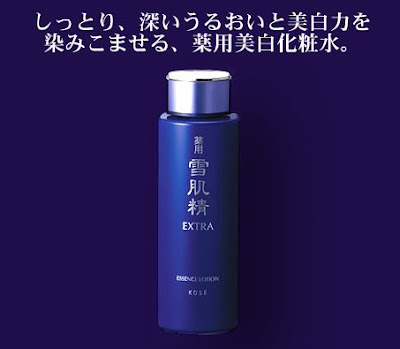
(Kosé Sekkisei, one of the best-selling
whitening line in Japan ever)
(image from www.kose.co.jp)
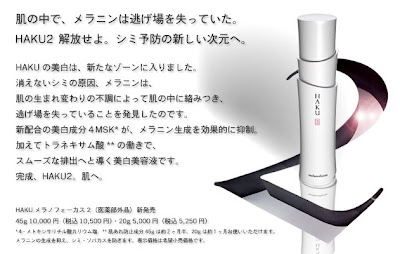
(Shiseido Haku 2, a recent sensation)
(image from www.shiseido.co.jp)
Last week, one of my readers asked me to write about whitening products in Japanese cosmetics. Since a friend of mine in the US also asked me about them a while ago, I decided that it was the time to highlight them on my blog.

I need to say at the onset that there is a reason why I have not talked about them, and it is that most of them simply don’t live up to their claims. Despite that, there are various aspects of this major Japanese skincare “phenomenon” that I would like to present, so this will be an extended post.

First of all, just to be clear, whitening products sold in Japan and some other Asian countries are not skin-bleaching products, the sales of which are illegal in many countries around the world. If the mechanisms of whitening products do work, what they do is to bring the coloration of the skin back to the tan-less state.

Most major Japanese cosmetics brands have a fully-fledged whitening line, with products from cleansers to foundations. The most established brands even have several different whitening lines. For example, Shiseido has UVWhite, White Lucent, and the recently very successful Haku (seen above).
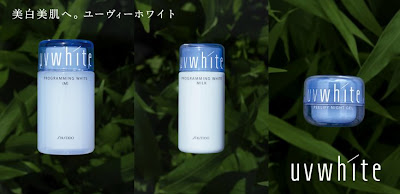
(Shiseido UVWhite)
(image from www.shiseido.co.jp)

Many major western cosmetics lines also have Asia-exclusive whitening lines:
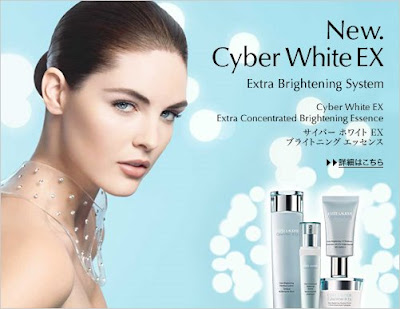
(Estee Lauder Cyber White EX)
(www.esteelauder.co.jp)
(Lancôme Blanc Expert Neurowhite X³)
(image from www.lancome.jp)
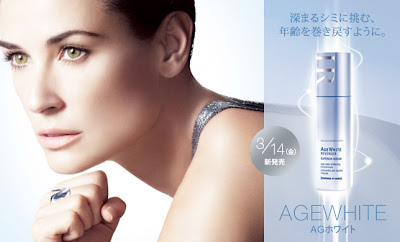
(Helena Rubinstein Agewhite Reverser)
(image from www.helenarubinstein.jp)
One key thing to bear in mind is that, in Japanese cosmetics, “whitening” and “brightening” are usually two facets of one skincare concept. In the most general terms, whitening products incorporate melanin inhibitors and exfoliating agents to attempt to fulfill their promises. While melanin inhibitors are supposed to slow down the production of melanin and, as an indirect result, help the existing tan to fade faster, the exfoliating agents clear out the dead skin cells so the skin looks smoother and more even and therefore appears brighter and “whiter”.

With this concept as the basis, many Japanese and western cosmetics brands have a full whitening skincare and base makeup range. Typical items include:

Makeup remover & face wash: They are designed to deep cleanse the skin and get rid of dead skin cells.

Toner: It often has exfoliating agents like fruit acids and more than a fair amount of alcohol to help strip off the dead skin cells.

Serum: It is usually billed as the key item of a whitening line and is supposed to have the highest concentration of melanin inhibitors and, in some cases, exfoliating agents. Counter assistants usually recommend the serum if one wants to venture into whitening skincare products but doesn’t want to invest in the whole line.

Mask: More melanin inhibitors and exfoliating agents.

Nighttime moisturizer: More melanin inhibitors and exfoliating agents.

Daytime moisturizer: It usually has a high SPF (around 30 or more) and PA level. (PA indicates the level of UVA protection, ranging from PA+ to PA++++.) It usually also incorporates micro light-reflective particles to give an illusion of brightness and luminosity.

Concealers/ foundations: Again, high SPF and PA as well as a lot of light-reflective particles.

A more elaborate whitening line usually includes items like:

Wipe-off lotion: It is used right after cleansing (and before toning) to further strip the dead skin cells off the skin. It is used on a cotton pad and applied in a wiping (not patting) motion.

Massage cream: Used right after cleansing (and after the wipe-off lotion), it attempts to boost blood circulation and to combat dullness in order to achieve a brighter complexion.

Eye cream: It is specifically for the eye area and is not necessarily targeted at getting rid of dark circles.

So, do they actually work?

In most cases, quite unlikely. The reason why they don’t usually work is very similar to why self-proclaimed anti-aging skincare products don’t usually work. Whitening products exist mainly because customers want to be told that they can achieve what they want to achieve. This is exactly how anti-aging products market themselves. (Almost coincidentally, wearing a sunscreen happens to be the simple answer to both anti-aging and whitening…)

Also, in Japanese cosmetics, whitening products are by far the most frequently revamped products. (A complete new line or new additions to an existing line are usually brought out at this time of year because the weather is about to get warmer and sunnier and people start to get more concerned about sun exposure.) With most brands, the whitening range gets revamped (to various extents) every year or every other year. Most companies want customers to believe that the whitening technology is improving, but, in almost all cases, products are not delivering the goods, so new ones need to be brought out, with new pseudo-scientific claims and new glowing results from non-independent research.

Plus, I rarely hear people missing a certain whitening product when it is discontinued and replaced by a new version. That alone is quite telling.

On a personal level, for a couple of years quite some time ago (when I was avidly experimenting with all kinds of skincare products), some of the whitening products that I tried are the harshest skincare products that I have ever used. Many Japanese toners and moisturizers already have a lot of alcohol (which simply should be avoided in any skincare product), and whitening toners and moisturizers sometimes have even more. (Despite its popularity, Kosé’s Sekkisei is perhaps one of the most skin-irritating products I have ever tried, as it is heavily loaded with alcohol.) Judging by the ingredient lists of many current whitening products, it seems that nothing has changed.

(To be fair, I am sure there are a few whitening products that are a little more gentle. Out of the several that I bought during that time, only the whitening serum by Sofina was something I remotely liked. It was free from alcohol and exfoliating agents. What it achieved was simply a more even complexion, but so can any well-formulated moisturizer.)

On a related note, every year, the names of a brand’s whitening line and individual whitening products incorporate such blatantly suggestive terms, so much so that I find them almost amusing.
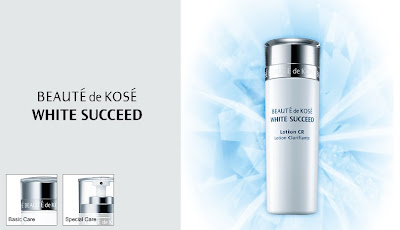
(Beauté de Kosé White Succeed)
(image from www.kose.co.jp)
Here are just some of the names (of current and previous whitening lines) to show how some cosmetics companies desperately want to convince customers that their products are the answer to everything:

Helena Rubinstein: Premium White (2006), Divine White (2007), Age White (2008)
Guerlain: Perfect White
Givenchy: Doctor White
Estee Lauder: Cyber White
Lancôme: Blanc Expert NeuroWhite
Clinique: Active White (2005), Derma White (current)
Cosme Decorte: Whitelogist
Pola: White Shot Melano Shooter
SKII: Whitening Source Derm-Revival
Dior: DiorSnow Sublissime
Origins: Light Years Ahead

Currently, the Kanebo website is building up to the grand launch of their latest whitening serum. The name:

Whitening Conclusion

I can’t help but wonder what they will name their new whitening product in 2009. I am extremely curious…

(On a minor note, as you might have observed, a lot of ads for whitening products feature blue as the predominant accent color. In Japanese culture, blue denotes purity, lucidity, and transparency and goes well with the idea of whitening products.)

However, there is still a lesson to be learned from this whole whitening phenomenon in Japan, which doesn’t involve whitening products themselves. Because many Japanese people strive to have a milky and porcelain-white complexion, they tend to be very diligent and almost religious about applying sunscreens.

So, even though their long and winding road to a perfect/premium/divine/active/cyber white complexion might be never-ending, at least they are keeping their skin optimally protected against the harmful and aging UV rays and maintaining a healthy and youthful appearance of their skin.

Related Posts:

A Touch of Blusher‘s Anti-Aging Series

Sunscreen Basics

10 Golden Skincare Rules

{ 22 comments }

New Side Bar Categories Added!

by PJ on Monday, February 25, 2008

in announcement, makeup, skincare, stash focus

I have added two new categories on my side bar so you can locate my past posts more easily:

My Current Makeup Favorites

My Skincare Essentials

The items in “My Current Makeup Favorites” include both some of my long-term staples and seasonal favorites. “The Skincare Essentials” feature items I am using on a daily basis now.

I will update these two categories constantly to reflect my current preferences (especially regarding my seasonal favorites), so do check back!

{ 0 comments }

(Come back to my purse!)

Every year, Biteki‘s reader survey reveals interesting aspects of their readers. In the last couple of years, I have found some statistics particularly fascinating.

Among the recently surveyed 664 Biteki readers (average age 31.2), their average monthly expenditures on makeup and skincare (in 2007) are:

Makeup: 8030 Yen (74.8 USD, 38.5 GBP)

Skincare: 13110 Yen (122.1 USD, 62.8 GBP)

(from Biteki February 2008, p. 38)

When I compare my own expenditures with the average figures, there are some intriguing observations.

First of all, I used to spend more money on skincare than on makeup products. But, in recent years, it has been the opposite. At the moment, purely in terms of the ratio between my skincare and makeup expenditures, mine is somewhat close to the reverse of what we see above.

Secondly, I was particularly fascinated by the expenditure on makeup. The people surveyed are Biteki readers, who are probably more interested in cosmetics and more eager to try out new products than the rest of the general public in Japan. If this is the case (and if we think about the four potentially “damaging” bombardments of seasonal collections every year), it appears that 74.8 USD, for them, isn’t a large sum of money and leaves relatively little room for experimenting or collecting after the regular re-stocking (like replacing mascaras and refilling the foundation). (Bear in mind that it is entailed that some surveyed readers spent less or much less than 74.8 USD per month.)

Also, most of the products on the readers’ favorite lists are from high-end department store brands and would eat up a big portion of the 74.8 USD. (For example, both the readers’ favorite eye palette (from Lunasol) and powder foundation (from Albion Exage) cost around 50 USD.) From this, it appears that the average Japanese consumer is quite selective in buying cosmetics.

Thirdly, while I do think that 122.1 USD can be quite a lot to spend on skincare products in a month, this amount doesn’t strike me as unusual. Apart from the fact that Japanese brands tend to update their skincare lineups much more frequently than most western brands, it seems that many Japanese brands feature more elaborate skincare routines. So there are potentially more products to purchase on a regular basis.

What is your take on these figures? Are these average spendings more or less than what you would expect? How would you compare your spending habits with those of a typical Biteki reader in Japan? Have your spending habits and preferences changed over the years?

Related Posts:

Biteki Readers’ Favorite Cosmetics Products in 2006
(Find out what they are!)

My Ultimate Makeup Archive
(getting larger month by month)

{ 10 comments }

(Lancôme Tonique Douceur)

Since I have quite sensitive skin, I think I am rather picky about what skincare products to use.

Just like makeup, old favorites get discontinued and we look through new candidates. I used to love Shu Uemura’s Refreshing Lotion, but it was discontinued a couple of years ago. After I used up my last bottle, the audition process started again.

Although there are a couple of toners I really like from Japanese brands not available in the UK, when it comes to skincare products, I tend to use what is available locally. It makes shopping (and restocking) a little easier.

I think Lancôme‘s Tonique Douceur has been around ever since I started to be interested in cosmetics. I am not sure if the formula has ever changed, but when I tried samples of it in the past, I did like them. After comparing it with a couple of others just to be sure, I decided to settle on Tonique Douceur.

It is alcohol-free and has a light, soothing, and refreshing feel. (I don’t really like toners with a serum-y texture or those that leave a slippery film on the skin.) I find that it eases up the mild redness of my skin and helps the skin look clearer and more transparent.

Also, the ingredient list is shorter than those of a lot of other toners I have come across. For people with sensitive skin, the fewer ingredients applied on the skin, the better.

After water and glycerin, rosa centifolia flower (rose hip) water is third on the ingredient list. According to Paula Begoun’s Cosmetics Ingredient Dictionary, rose hip has antioxidant properties. It is a pity that the toner is packaged in a transparent toner. Otherwise the antioxidant properties would last longer.

I usually don’t use cotton balls or cotton pads when applying a toner. I dispense 4 or 5 drops of a toner, spread them across my palms, and gently pat the toner onto the skin. (I put Tonique Douceur in another bottle with a pump dispenser so I don’t accidentally pour too much out.) During the application, I also like to cover my cheeks and eyes with my palms and do some deep breathing. I find it very calming.

Overall this is a toner that really suits my slightly sensitive skin, and the fact that I don’t use cotton balls/pads also makes a 200ml bottle go a long way.

(Please note that Tonique Douceur contains fragrance and preservatives. Do make sure you read through the ingredient list if you have relevant concerns.)

Related Posts:

Other steps of my skincare routine:

Makeup remover

Daytime Moisturizer

Nighttime Moisturizer

Lip Balm

{ 16 comments }

Possible Sephora Re-Launch in the UK!

by PJ on Monday, January 28, 2008

in _Bring It Back, makeup, skincare

(I want it back!)
(image from www.sephora.com)


According to WWD, Sephora has been in talks with Marks & Spencer regarding opening shop-in-shops in the UK’s leading highstreet department store.

This is very exciting news, and it would certainly be great to see Sephora back in the UK!

If you also want to see Sephora back in the UK, you can still sign the petition started by Charlotte at Kiss and Makeup in August last year.

Updated on January 29th 2008:

Charlotte at Kiss and Makeup has posted additional information on the possible re-launch. Have a look!

Related Posts:

The “Bring Back Sephora” Campaign
(Umm…has it actually been working? Keep it going!)

A Touch of Blusher’s “Bring It Back” Series
(brands and products I want to see again…)

{ 8 comments }

(RMK Cleansing Oil N)
(image from www.rmkrmk.com/global/)

RMK Cleansing Oil N is the cleansing oil of my choice before and after I was using the cheaper Boots Botanics Essential Oil Wash Off Cleanser, and this is one of my favorite makeup removing products.

To be specific, Cleansing Oil N, out a couple of years ago, is the new version of Cleansing Oil. But I don’t feel that there is any substantial difference between the two versions. Both are equally great.

Like most other cleansing oils, this one cleanses very effectively and melts all water-proof makeup. But three aspects of this cleansing oil stands out for me:

1. It emulsifies very well upon rinsing. There are several cleansing oils I have tried that don’t emulsify very well and leave a greasy film. Even after using a face wash, sometimes my face still feels somewhat greasy. This one leaves the skin very cleansed and fresh. Very occasionally I even forget to wash my face with a face wash immediately afterwards.

2. It is very gentle for my eyes. A couple of cleansing oils that I actually really like can leave my eyes dry if they get into the eyes while dissolving eye makeup. This one is very gentle for the eye area and never feels irritating.

3. With mainly olive, avocado, and grape seed oil, the texture is very light and it spreads wonderfully easily. I find that I don’t need as much per appplication, compared with other cleansing oils.

I am very glad that RMK became available in the UK several years ago, so there was no doubt which cleansing oil I was going to switch (back) to after the Boots Bonatics Oil Cleanser was discontinued.

(Note: Currently, UK is the only place outside Asia where RMK products are available.)

Updated on January 27, 2008:

In the comment section, Jami from Bionic Beauty asked about the ingredient list of this cleansing oil. So here is the full ingredient list of RMK’s Cleansing Oil N that I happen to have saved for future reference. (Please click on the photo for a much larger version.)

(the full ingredient list of RMK Cleansing Oil N,
on the back of the outer packaging)

Related Posts:

I also can’t live without:

Garnier Hand Cocoon

Dove Body Silk

{ 23 comments }

(sales ad from Selfridges & Co.)

(image from www.selfridges.com)

I was surprised when I went to my first seasonal sale in London years ago (at the start of the winter sale on December 27th). In the most high-end department stores, a lot of limited-edition beauty items from a couple of seasons ago had a mark-down between 30 to 50 percent. I didn’t expect to see them, but then they were back and stacked up at the edge of the counter.

I soon realized that, during seasonal sales in the UK, cosmetics items are reduced just like clothes are.

There are mostly 4 types of beauty products that are marked down in UK seasonal sales:

1. Seasonal gift sets, especially fragrance sets. (Christmas fragrance sets usually have a 30% mark-down right after Christmas. Many people stock up their favorite fragrances at this time of year.)

2. Limited-edition makeup items. Dior, YSL and Guerlain do this the most, among many other (mostly French) brands.

3. Discontinued and soon-to-be discontinued products. If I see a couple of products from a brand’s current lineup being reduced massively (sometimes up to 50%), I know they are going to be discontinued very soon. (Or, if I know something is going to be discontinued or replaced, I’d expect it to be on sale.)

4. Surplus stock of makeup shades that are less popular.

So here are just some of the things I saw this time:

— Guerlain’s Pucci collection (limited-edition, summer 2007), 50% off
— Guerlain’s 4-color eyeshadow palettes, 50% off (the new range has replaced these).
— YSL Palette Esprit Couture (limited-edition, fall 2007), 30% off
— YSL limited-edition items for summer 2007 and holiday 2006, 50% off
— Dior Diorissime palettes (limited-edition, fall 2007), 30% off
— Various Dior eyeshadow palettes and lipsticks, 30% off
— Paul & Joe’s discontinued base makeup items (change of packaging and formulation in summer 2007) and the full nail color line (soon to be replaced by a new nail color range), 50% off.

For the first time, I saw fall limited-edition makeup items, such as Diorissime palettes, reduced right after Christmas in the same year. But, with spring collections out earlier and earlier, maybe it is not all that surprising.

I have always been in two minds about all the clearing out. Of course it is nice to buy things at reduced prices. I have bought some lovely Paul & Joe items during the sale for very affordable prices.

However, even though high-end brands have a certain image and cache that they try hard to maintain, some of them still haphazardly stack up discounted palettes at the counter. Lip glosses are bundled up in rubber bands and put in plastic boxes. I can’t help but feel that this is rather unsightly and that the only thing they aim for during the sale is to get some stock space back. It doesn’t really reflect elegance and sophistication.

(True to its Japanese roots, Paul & Joe’s attention to detail during the sale stands out. In Fenwick on Bond Street, Paul & Joe’s reduced items are usually lined up neatly on a small and simple round table next to the counter. No plastic boxes or rubber bands…)

As I understand, there are clear-outs like this in the US for brands that are going to be discontinued. But it appears to me that seasonal limited-edition makeup items from high-end brands are not usually marked down regularly like they are here in the UK.

In some other countries (as well as in the US), I am aware that there are similar seasonal beauty clear-outs, but they are done in companies’ warehouses or headquarters. These events can be slightly more exclusive in terms of how they publicize the event information.

Are cosmetics items reduced regularly like this in your country? Let us know!

Voice more of your opinion on:

Can I return this, please?
(Can you?)

You Mean It’s Not Real?
(Are there problems with mascara ads?)

Japanese vs. Western
(Which side are you on?)

{ 14 comments }

(Olay Complete Care Night Enriched Cream)


Happy new year everyone! I wish all of you a healthy and happy 2008!

Today I am talking about my current nighttime moisturizer. In my post on my daily skincare routine, I mentioned Lancôme’s Hydra Zen was my chosen moisturizer for nighttime. But, about six months ago, Hydra Zen changed its formulation for the fourth time. Unlike the last three times, when there were only minor changes, the 4th-generation Hydra Zen’s ingredient list looks very different. It is still a suitable moisturizer for me (I used a couple of samples), but it was apparent to me that my skin didn’t like it as much.

I decided to look for a replacement. Usually, finding a replacement skincare product can be painful and can involve wasted money. (Opened and used cosmetics products are not returnable and refundable in the UK.) But, since, at that time, I had just started to like Olay Complete Care Daily Illuminating UV Fluid SPF 15, I thought I’d tried another moisturizer from Olay.

The one I got is Olay Complete Care Night Enriched Cream. It sounds like it is really dense and possibly greasy. But, when I tried the in-store tester, it seemed clear that it was not. It seemed light but still emollient, and it appeared to be suitable for my oily-dry skin. With Olay being a relatively affordable brand, I thought I’d try it out.

I really liked it the first time I used it. Even though it has a cream consistency, it is surprisingly lightweight and has a good slip. It is moisturizing and absorbs well, but it doesn’t feel heavy or look greasy at all. For me, it is a competent moisturizer for all seasons. Obviously, this is the first winter when I am using it. All I need is just to use a bit more of it than I do in warmer months, and I don’t need to layer on any other product.

One thing worth mentioning is that one of the major ingredients in this moisturizer is niacinamide. Paula Begoun describes ingredients like niacinamide and retinol as “cell-communicating ingredients“, which are able to work effectively at the cellular level to help improve the conditions and appearance of skin. (Read more about niacinamide and cell-communicating ingredients on Paula Begoun’s website.)

It contains benzyl alcohol, which can be a skin irritant. But it is not among the major ingredients and I have not had negative reactions to the product.

Overall this is a well-formulated moisturizer that happens to have the texture and the degree of emolliency that really suit me. I am quite positive that, as long as it remains available in the UK, I will continue to use it.

Related Posts:

10 Golden Skincare Rules
(Let’s try to follow all of them in 2008!)

A Touch of Blusher’s Anti-Aging Week
(my week-long series on facts and thoughts on anti-aging skincare)

{ 12 comments }

(image from www.dhcuk.co.uk)

One of my readers, Humming, left a comment on my blog a couple of days ago and told me that the DHC UK website had been launched. (Thank you, Humming!)

DHC now joins RMK, Paul & Joe, SUQQU, Shiseido International, and Kanebo International as Japanese brands available in the UK.

DHC is a major cosmetics brand in Japan, where, as far as I understand, still only runs mail/phone/on-line ordering and does not have a physical shop.

But, as we all know, word of mouth has its place in retailing, and when people say something is good, it gets our attention.

(Updated in July 2011: DHC has physical shops throughout Japan.)

DHC’s cult product is Deep Cleansing Oil. Not only is it DHC’s cult product, it is one of the cult skincare products in Japan. It would be slightly bizarre not to see it on a readers’ favorite skincare product list in any Japanese cosmetics magazine. (In the readers’ poll results in Biteki‘s February 2007 issue, it was placed second in the favorite makeup cleanser category, one place above Shu Uemura’s cleansing oil.)

It works just like Shu Uemura’s cleansing oil and removes all makeup, including waterproof makeup, in one go. (There is a good review of it on Beauty Anonymous if you are interested!)

I tried the Deep Cleansing Oil many years ago, but I personally didn’t like it. It did cleanse very effectively, but I was fairly certain that it gave me breakouts. (I have also tried Shu Uemura’s various cleaning oil formulas, but I usually find that they don’t emulsify well enough. For years, I have remained loyal to RMK’s Cleansing Oil and Boots Botanics Cleansing Oil.)

But, since that was many years ago and I live in a different climate now, I might consider giving it another go. Also, many DHC toners are alcohol-free and have simple formulations that have the potential to suit my sensitive skin. They will be the products I will pay more attention to.

So far, only the basic skincare items are sold on the DHC UK site. I hope the stock will be expanded later on. In the meantime, if you would like to see the vast array of DHC skincare and makeup products, do head over to the DHC US website. (But…do ignore the fact that the prices are, yet again, lower in the US…)

Related Posts:

My Daily Skincare Routine
(featuring RMK Cleansing Oil)

All About Japanese Cosmetics
(My love for Japanese cosmetics will never end…)


{ 10 comments }